
How to Search Civil Dockets
Two tools do most of the work. The Porter County adult-records gateway comes first, and Indiana Odyssey/MyCase is the second stop. Pick Porter County and the Civil, Family, or Probate category that fits. The Case tab takes a Porter number. The Name tab keeps a person's name apart from the Business field, which matters when a company filed the suit.
Go broad with a name query. Civil records often lack birth dates, so that filter can bury a valid result. Before reading docket events, confirm the basics. Check the court identifier, case type, filing date, party roles, and status.
- Open MyCase and select Porter County.
- Search the case number, personal name, business name, or attorney.
- Choose the matching civil, family, or probate category.
- Read service, pleadings, motions, settings, and orders in date order.
- Request an official judgment or pleading from the clerk when needed.
Porter Civil Search Tabs
MyCase splits its interface into Case, Name, and Attorney tabs. Case takes a single identifier at a time. Name offers personal-name fields, business name, birth date, and a sounds-like option. Advanced controls add open or closed status and filing-date bounds. Filters shrink a large result set. Yet stacking every field can crowd out the correct Porter County civil docket.
For the official layout of these tabs and civil categories, see the MyCase search page.
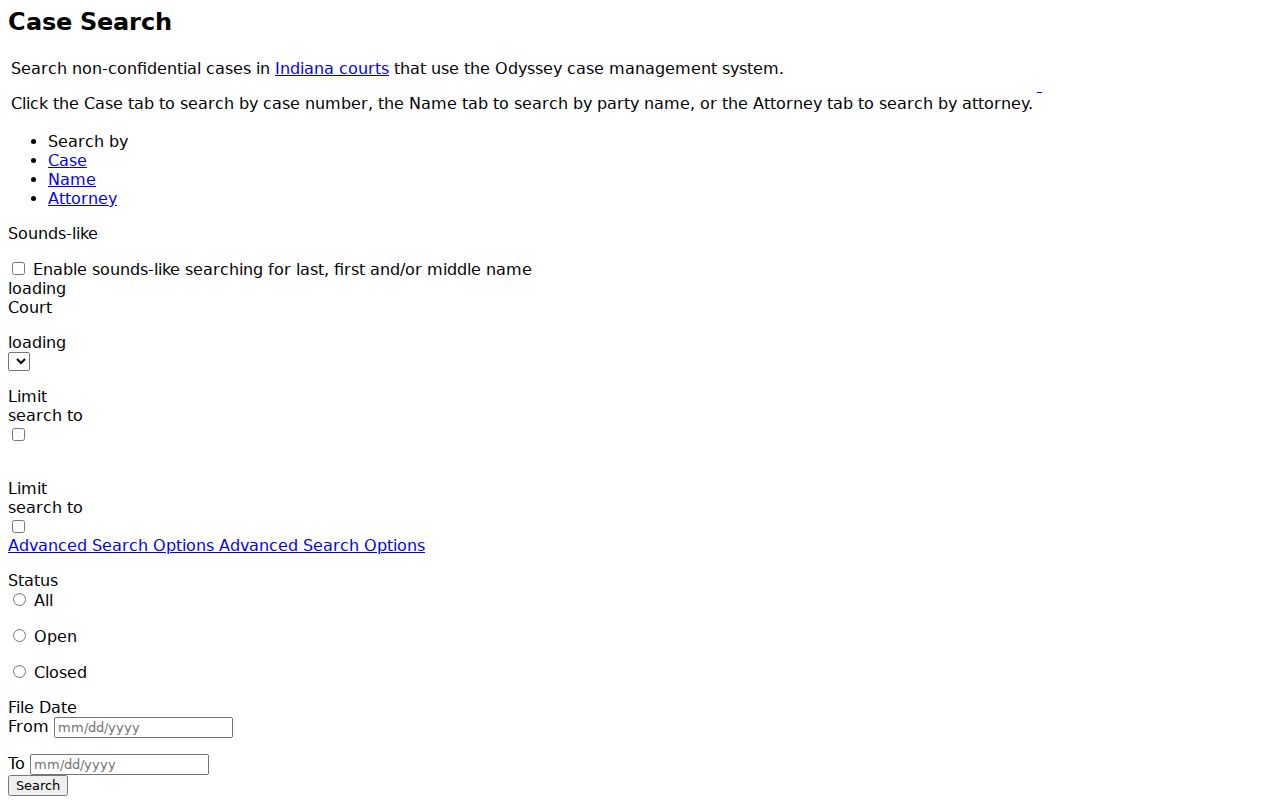
The split between party name and business name pays off most in contract, collection, and foreclosure files. Organization-filed cases are common there, and searching the right field finds them faster.
What a Civil Docket Shows
Each Porter civil docket opens with the court, case type, filed date, status, and caption. Party roles run from plaintiff and defendant to petitioner, respondent, guardian, or trustee. From there the CCS logs everything. It records appearances, service, complaints, answers, motions, responses, hearings, orders, judgments, and enforcement. One caution: a filed motion is just a request. It stays a request until an order resolves it.
| Case Number | A format such as 64D01-2501-CT-000123, with court, period, type, and sequence. |
|---|---|
| Parties | Caption, public roles, and counsel or appearance details. |
| Filings | Complaint, answer, counterclaim, motion, response, or amended pleading. |
| Settings | Conference, mediation, motion hearing, trial, or review. |
| Judgment | Order, dismissal, settlement, default, or enforcement entry. |
Porter Civil Court Allocation
Porter's Superior Division pairs ordinary civil, family, and probate assignment lanes across Superior Courts 1, 2, and 5. Local rules send PL, CT, TS, TP, EV, and MF types through Odyssey random or rotating allocation. Related-case and special-judge rules still apply. Collection work moves differently. CC cases travel in batches of 20, starting at Superior 1 and then rotating to Superior 2 and 5.
| Case lane | Porter routing clue | Search check |
|---|---|---|
| PL, CT, MF, EV | Superior Division rotation | Confirm 64D01, 64D02, or 64D05 |
| CC collections | Twenty-case batches | Do not infer court from party location |
| SC small claims | Township venue | Check original and converted number |
Types of Civil Cases on the Docket
Porter County civil dockets run on Indiana case-type codes. A code tells you which MyCase category to pick and how to read the assigned lane. Access varies inside each type, though, since protected addresses, family data, medical details, and confidential attachments can change what the public sees.
- PL and CT plenary, tort, or contract matters
- CC collection and MF foreclosure cases
- EV eviction and SC small-claims cases
- DR and DC domestic-relations matters where public
- ES, GU, and TR estate, guardianship, and trust matters
Porter Small Claims Follow Townships
Small claims skip the broad civil rotation. Porter local rules set venue by township instead. Superior 4 covers Washington, Boone, Pleasant, Center, Union, and Porter townships. Superior 3 and 6, on the Portage side, take Jackson, Liberty, Pine, Portage, and Westchester. A city name alone never proves which court holds the docket.
Conversions happen, too. A small claim can become a plenary, tort, contract, or collection case. That brings a new identifier and a different fee. When that appears, run two searches. Use the original SC number and the later PL, CT, or CC number. Note: Township venue and case conversion can shift the court number even with the same parties and dispute.
Settings and Hearings on Civil Dockets
Civil settings cover initial conferences, pretrials, mediation, motion hearings, evidentiary hearings, trials, compliance reviews, and supplemental proceedings. Always read the CCS entry for a setting together with its linked order. A calendar date proves an event was set. It proves nothing more. A later order may still continue, cancel, or entirely replace that date.
The Indiana Court Calendar shows only participating Porter courts. Its date window is limited, so lean on MyCase for the fuller history. For Superior 2, 3, or 4, confirm a setting by phone with the assigned court. Local rules disfavor routine continuances and require stated grounds. The entered order is still what decides whether a date moved.
Porter Civil Filing Costs
Fees are published on the Porter County civil cases page. A civil filing totals $157. One-time sheriff service adds $28, and the displayed total becomes $185. Added defendants or garnishees can add $10. The page states the conditions.
| Published item | Amount |
|---|---|
| Civil filing total | $157 |
| One-time sheriff service | $28 |
| Total with sheriff service | $185 |
| Added person or garnishee under listed conditions | $10 |
Treat these as filing examples, not a case balance or certified-copy quote. The clerk confirms current costs.
Public Access to Civil Dockets
Indiana Access Rule 4 presumes court records are open unless another rule, law, or order excludes them. Access Rule 5 then shields listed records and confidential cases. Family, protective-order, mental-health, medical, address, and identifier material may stay limited even when other docket entries remain public.
Read the absence carefully.
A missing link can mean the paper is not digitized, restricted by audience, or available only from the clerk. It does not prove the filing never existed.
Need a missing or official record? Reach the Valparaiso Clerk at 16 Lincolnway, Suite 209/211, 219-465-3450. The Portage annex sits at 3560 Willowcreek Road, 219-759-8212. Call first before mail, email, or fax, since no universal copy-request method is published. For a transcript, ask the court reporter rather than the docket search.
Certified Porter Civil Docket Records
The online CCS gives you a reference view only. Certified copies are different. A certified pleading, judgment, or order must come from the Porter County Clerk of the Circuit Court. That office keeps the official file and seal. Have the case number, document title, and filing date ready before you ask. Even when MyCase shows no document link, older paper may still exist. Archive routing can require the records coordinator.
Porter County publishes no general certified-copy form and makes no firm turnaround promise. State clerk guidance sets a baseline of $1 per legal or letter page plus $1 for a certificate under seal. That is not a confirmed Porter invoice. Before sending payment or private data, ask for the total, the certification, your delivery choice, postage, and the completion time.
A transcript is not part of the civil docket or the filed-document copy. Request one from the reporter or the maintaining court. Give the hearing date, the judge or court, and the format you want. Clerk staff can explain public availability and copy steps, but they never decide what a filing legally means. For an older court record, ask whether the archive holds paper or microfilm. Ask whether pickup, mail, or electronic delivery works.
Reading Porter Civil Docket Events
Order matters when you read a Porter County civil docket. Begin with the complaint or petition. From there, find service of process and each party's appearance. Service entries show that notice steps were recorded, nothing more; they do not decide the claim. Watch for an answer, counterclaim, crossclaim, or amended pleading. Any of these can change the issues in court. A motion is a request for action. The linked order or RJO entry tells you whether the court granted, denied, or deferred it.
Read defaults just as closely. Porter local practice includes a short grace period, but service, appearance, and the actual judgment entry still control. A hearing scheduled for default is not itself a final judgment. Treat settlement language in a CCS entry with caution. Check the filed agreement, dismissal, or consent judgment too. That is what closed the matter. With an enforcement or supplemental proceeding, trace the docket back to the original judgment. Note any later satisfaction entry.
Family, probate, and protective-order dockets often show fewer public documents than a routine contract case. Protected addresses, support data, medical material, and confidential attachments can be withheld. The public event text stays visible. A party or attorney may see more under Indiana's document-access matrix. Is a title missing? Ask the clerk about it. Do not assume every filing should appear as a MyCase link.
Porter Civil Forms and Filing Routes
The Porter County forms collection brings many filings together. Small-claims notices, counterclaims, default-judgment papers, proceedings supplemental, eviction complaints, debt affidavits, and agreed judgments all sit in one place. Remember what these are: filing tools, not requests for copies of an existing docket. Attorneys file through Indiana's e-filing workflow. A self-represented filer can use the Clerk's Office counter. Once something is filed, the CCS records the event and the court applies the local assignment rules.
Researching a case that already exists? Use the form title only to understand the event. Never submit a new form just to obtain a record. Ask the clerk for the filed paper. Give the case number and title. Request certification separately when you need an authenticated copy.